As rumored awhile ago, Google indeed run their own Super Bowl commercial right after the 3rd quarter of the games.  And staying true to what it has grown accustomed to doing, Google’s Super Bowl ad was very simple sans all the fanfare of other Super Bowl ads. Google was not advertising any upcoming product or gadget or anything but rather decided to show the power of its localized  search engine. Simple as it is, the ad was able to convey its message well and has probably endeared many who have watched it.
Actually Google’s ad dubbed “Parisian Love” is an old clip. It has been on YouTube for three months now. So, instead of coming up with an explosive ad which could have cost them a lot of money, like the other ads Google was able to save some money as well. Except for the $30 million fee that it has to pay for the highly coveted 30 seconds  Super Bowl slot.
In case you’ve missed it during the airing, the Google Super Bowl commercial started with a search for “study abroad in paris france” and ended with “how to make assemble a crib.”  Yup, it’s a love story  for crying out loud! It shows how Google search can be a part of everyone’s life.  Simple, straight forward and extra-ordinary way of telling a love story with the help of a search engine. You’ve got to give it to the Google folks for pulling this one out effectively.
Just a quick note to follow-up on the latest development about New York Times plan of introducing a paid model for its online newspaper. Â It is now official, NYT will be rolling out the paid-metered model beginning in 2010.
The metered model approach to making its loyal readers pay for their access to the New York Times will give users free access to a set number of articles per month. NYT will start charging users online when they’ve access more than the number of free articles. Â According to NYT, this is their way of creating a second revenue stream that will somehow help in preserving the online newspaper. Furthermore, offering the NYT online on a paid subscription basis will also give them the flexibility to keep an appropriate ratio between free and paid content – hence helping them stay connected to the Internet.
To prepare the online NYT, new online infrastructure will be designed.  The good news is,  those who subscribe  to the print NYT will continue to have free access to the online NYT, even when the paid model system is already implemented.
NYT Chairman Arthur Sulzberger expressed confidence that the loyal NYT users would not mind the paid model since it will help the NYT improve on its content.
“Our audiences are very loyal and we believe that our readers will pay for our award-winning digital content and services.”
Pricing and other details about the new paid model will be released in the coming months. In the meantime, you’ge 11 more months of free access to the NYT online, so make the most of it.
If Moto Droid’s controversial ad campaign sparked some tremendous amount of buzz in the U.S., its European counterpart, the Motorola Milestone seemed to be a tamer version. The Moto Milestone is currently available  in most Europe mobile distributors and earlier report from Expansys indicates that sales is starting to pick up, slowly.
Maybe the dull and boring ad campaign is not helping out Motorola to gain some market momentum for the Milestone? Or is it because Europeans are still not ready yet to embrace Android?
Now, going back to the ad campaign, any idea as to why the European version is not as hard-hitting to iPhone as the American ad campaign? Right now, I could only think of one thing – that Motorola was not after all behind the ad campaign that kept on attacking the iPhone and even AT&T. So, it’s quite obvious that Verizon is the mastermind of the iPhone bashing after all.
Anyway, Motorola Milestone’s video ad aside from not hitting any competitor was also nicely done with a bit of serious tone. It actually suits well with the Motorola Milestone’s features.
So, which of the Motorola Droid/Milestone’s video ads do you like better?
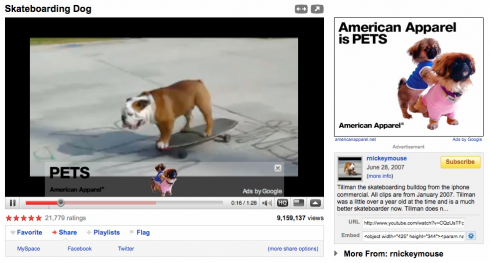
If you’re closely following our beats here at 901am, you’ll surely noticed that we’re so fond of news with accompanying YouTube videos. This is fine and good since YouTube is part of the new media. Now much as we don’t want to annoy you our dear readers with videos running various targeted ads, we can’t help it because it’s beyond our control.
And guess what? Expect to see more of those ads as YouTube announced that they are rolling out a video targeting tool which advertisers can use to find appropriate videos where their ad campaigns will run on. Google really wants to push video ads, thus it is giving advertisers more control of their ad campaigns by letting them choose specific YouTube partner content they’d like to target.
The new video targeting tool is also flexible enough that advertisers can discover videos relevant to their campaign easily as well as their target audience. The tool would even suggest videos based on keywords, viewer demographics, and interest-based graphics.
In short, YouTube has established an advertising marketplace where video targeting options result in extra control and better brand for display advertisers.
And what this gives us YouTube fans – more annoying video ads, slow loading time and possibly the need to find another place to satisfy our video content hunger. Don’t get me wrong here – if it’s all for the good and sustainability of YouTube, well and fine. I just don’t dig if consumers are really acting upon ads they encounter on YouTube videos. Have you?
It’s December folks and both AT&T and Verizon must have already felt the Christmas spirit. Â AT&T decided to drop the lawsuit it filed against Verizon for putting up an add that misinform its customer about AT&T’s 3G coverage.
If you will recall, Verizon’s “There’s a Map for That”  alluded that AT&T subscribers cannot access Internet services as compared to Verizon’s superior 3G network capability. This prompted AT&T to file a case against Verizon claiming that such ad was blatantly false and  has caused irreparable harm to AT&T. More →
After getting various mobile innovation-related awards from several advertising organizations, here comes Pizza Hut iPhone app again bagging another prestigious plum. This time it’s from “the” Forbes Magazine, which named it the #Branded Mobile Application of 2009. Of course, Pizza Hut iPhone app was also named as the first national pizza chain to release an ordering app, and that’s not counting the millions of profits generated by the app for the Pizza store.
If you’re an iPhone users and you have not downloaded the app yet, you might be missing a lot. Actually I might be missing a lot because I haven’t downloaded the app yet. But I have a good excuse, the app is not available in the country where I am located. More →
If the big honking banner ads on your favorite sites suddenly get less annoying over the coming months, here’s why: Google is buying display advertising startup Teracent.
Have you caught the two new iPhone ads shown on TV last night? Reports had it that the new iPhone ads were supposed to appear on shows such as “House”, “Dancing with the Stars”, “How I Met Your Mother” and other Daily Shows on Comedy Central.
Anyway, the ads are appended at the start and end of this post, so enjoy watching. In case you’re wondering what are those iPhone ads are all about. Rumor has it that it’s Apple’s subtle attack on Verizon Wireless which was in a mobile phone ads war with AT&T. AT&T of course is the exclusive distributor of the iPhone. So, you get the picture? More →
I knew the brilliance of the I’m a PC and Laptop Hunters ads couldn’t last. Reverting back to their usual retarded marketing style, Microsoft is now telling people to throw house parties in celebration of the Windows 7 launch — complete with horrible actors in a ridiculously awkward promo video.
Fortunately, by bleeping out the right words, you can turn the promo video from awkward to hilarious. The party suddenly sounds a lot more interesting.
Perhaps you’ll forgive this thought dump as I make a few personal observations about Google and its place in Britain.
Maybe you have your own thoughts about how Google is trying (officially or otherwise) to maintain its position as premier search engine.
Recently I’ve noticed a trend on TV ads where, instead of providing a direct web address, they invite the viewer to “search online for…”. However, they don’t specify which search engine you should use — merely that you should go online.
Obviously, this approach means that they’re fairly confident that the proposed search term will bring up their website. I wonder if they’re also assuming that most people will use Google?
Last week I saw for the first time a direct ad for Google. At the end of an advert for a pet insurance company, a Google page appeared on screen with the voiceover “Search on Google for Pet Plan”. More →