By Dennis Bouchand · Posted on February 12, 2009
One in five (21%) Internet users ages 13 to 54 now accesses streaming video to watch full episodes of TV programs, up from 10% in 2006, according to a new report from Knowledge Networks.
Two-thirds (65%) of these “streamers” say they expect to be able to watch their favorite shows on “the device of my choice.”
How People Use TV’s Web Connections, from The Home Technology Monitor, is now in its third year, detailing consumers’ changing use of and attitudes toward television network content on the Internet. The report shows that, among 13-to-54 streamers of TV network content,
• Use of third-party hosting sites (such as Hulu) to access TV network video content has doubled since 2007, from 14% to 28%
• he networks’ own websites are still streamers’ most common source of network content, with the highest level being among those ages 18 to 34 (68%)
• 87% say they view full TV programs online so that they can “watch a current episode that I missed” and 18% say they are “trying out a new program”
• 30% have forwarded a link to network content to somebody they know and almost half (44%) say they have received a link to network content from a family member or friend
Topics: Metrics, Video, Web · Leave a reply
By Dennis Bouchand · Posted on January 8, 2009
Mobile advertising marketplace AdMob has highlighted the explosive iPod Touch growth and smartphone Operating System (OS) market share in its December 2008 Mobile Metrics Report.
iPod Touch requests more than tripled worldwide from November to December, with a particularly large spike in requests the week after Christmas. The iPod Touch is now the second device in the AdMob Network with 4.7 percent share. While 70 percent of iPod Touch requests in December came from the US, it experienced strong growth across other major markets including Canada, United Kingdom, Mexico, Germany, and France. Combined, the iPhone and iPod Touch represent 15.5 percent of all worldwide requests.
Other highlights from the December 2008 report:
· Smartphone share increased from 22 percent of total requests worldwide in May to 33 percent in December.
· Symbian is the top smartphone OS worldwide with 41 percent share. In Asia and Africa it has more than 90 percent share, however the iPhone is challenging its dominance in Latin America and Europe.
· The iPhone OS had 32 percent worldwide share in December, up from 6 percent in May.
· Worldwide RIM has 10 percent and Windows Mobile has 9 percent OS share. Both are strongest in North America and Latin America.
· Palm has 4 percent of smartphone OS share worldwide with more than 95 percent of its requests generated in North America. In the US, Palm had 9 percent share in December, declining from 20 percent in July.
· Android already leads Symbian in North America with 2 percent of OS share.
Topics: Metrics, Mobile · Leave a reply
By Cristina Ledesma · Posted on December 19, 2008
The impact of the global economic crisis will spread to the mobile phone market resulting in a downturn in shipments in 2009. According to IDC, total mobile phone volumes will be 1.9% lower in 2009 than 2008 levels, the first downturn in annual shipment volumes since 2001 when shipments declined 2.3%. Over the past several years, the mobile phone market has enjoyed double-digit annual growth due to an increased emphasis on emerging markets. However, emerging market growth has been steadily slowing as these markets mature. IDC now expects worldwide growth to be just 7.1% in 2008 before slipping into negative growth in 2009.
The economic crunch has also affected consumer behavior, particularly consumers’ plans to purchase new devices. With less disposable income available and other expenses competing for attention, consumers may choose to hold on to their current devices rather than replace or upgrade them at the next possible opportunity, usually when a service contract expires.
IDC does not expect the downturn in mobile phone shipments to stretch past 2009. By 2010, the worldwide mobile phone market will show signs of improvement as economic recovery plans will have taken effect.
Topics: Metrics, Mobile · Leave a reply
By Dennis Bouchand · Posted on December 11, 2008
comScore has released the October 2008 data from the comScore Video Metrix service, reporting that U.S. Internet users viewed 13.5 billion online videos during the month, representing an increase of 45 percent versus year ago.
In October, Google Sites once again ranked as the top U.S. video property with nearly 5.4 billion videos viewed (representing a 40 percent share of all videos viewed), with YouTube.com accounting for more than 98 percent of all videos viewed at the property. Fox Interactive Media ranked second with 520 million videos (3.8 percent), followed by Yahoo! Sites with 363 million (2.7 percent), and Viacom Digital with 305 million (2.3 percent). Hulu, a joint venture of NBC and Fox featuring full-length broadcast TV programs, ranked sixth with 235 million videos viewed (1.7 percent).
More than 147 million U.S. Internet users watched an average of 92 videos per viewer in October. Google Sites attracted a record 100 million online video viewers, or more than two out of every three Internet users who watched video during the month. Fox Interactive ranked second with 60.8 million viewers, followed by Yahoo! Sites (45.2 million) and Microsoft Sites (30.7 million).
Other notable findings from October 2008 include:
- 77 percent of the total U.S. Internet audience viewed online video.
- The average online video viewer watched 274 minutes of video.
- More than 80 percent of the 18-34 year olds watched online video, higher than any other age segment. The average 18-34 year old online video viewer watched 4.8 hours of video during the month, also ranking above all other age segments.
- 99.5 million viewers watched 5.3 billion videos on YouTube.com (53.2 videos per viewer).
- 51.2 million viewers watched 520 million videos on MySpace.com (8.0 videos per viewer).
- The duration of the average online video was 3.0 minutes.
- The duration of the average online video viewed at Hulu was 11.6 minutes, higher than any other video property in the top ten.
Topics: Metrics, Video, Video Sharing · Leave a reply
By Dennis Bouchand · Posted on December 10, 2008
Burst Media has released the results from a survey on the topic of ad clutter. The survey was administered to over 4,000 web users with the purpose of better understanding how ad clutter impacts a web users’ Internet experience, as well as its impact on the perception of advertisers who place ads on cluttered sites. Overwhelmingly, the findings reveal that websites cluttered with advertisements do a disservice to the publisher, the advertiser and the visitor.
According to the survey results, ad clutter not only annoys the audience but it also diminishes ad effectiveness. An astonishing three-quarters (75.5%) of the respondents who remain on a site they perceive to be cluttered say they pay less attention to advertisements appearing on its pages.
Additionally, although respondents accept that advertising will appear on a web page, for a majority (52.6%), there is low tolerance for more than two advertising units per web page. More than one-quarter (29.9%) of survey respondents immediately leave a site if they perceive it to be cluttered. Women are more likely than men to abandon a site that appears cluttered – 32.1% versus 27.5%.
A resounding survey finding is the negative impact advertising clutter has on a consumer’s perception of an advertiser’s products and services. One out of two (52.4%) respondents has a less favorable opinion of an advertiser when their advertising appears on a web page they perceive as cluttered. One-half (56.4%) of women claim clutter negatively impacts their opinion of an advertiser, versus 48.3% of men.
The survey also found that ad clutter’s negative impact on respondents’ opinions increases with age. Less than half (46.8%) of respondents 18-24 years were impacted negatively by clutter whereas nearly two-thirds (63.2%) of respondents 55 years and older were unfavorably impacted.
Topics: Advertising, Metrics · Leave a reply
By Cristina Ledesma · Posted on November 25, 2008
comScore released its ranking of the top search properties in Japan based on data from the comScore qSearch service. In September, 5.9 billion searches were conducted in Japan with each searcher conducting an average of 96 searches during the month. Yahoo! Sites led in search query volume with 3 billion searches, followed by Google Sites with 2.3 billion searches.
Yahoo! Sites led the search ranking in Japan with more than 3 billion searches, representing a 51 percent market share, followed by Google Sites with 2.3 billion searches (39 percent market share). Rakuten Inc. captured the third position with 120 million searches (2 percent market share) and Microsoft Sites ranked fourth with 90 million searches (1.5 percent market share).
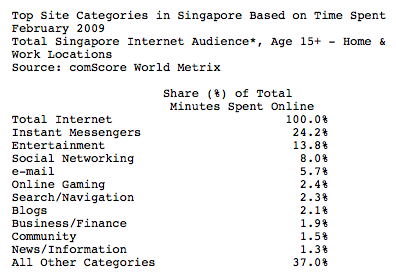
In September, more than 340 million searchers conducted nearly 29 billion searches in the Asia-Pacific region, ranking it as the largest searcher population and search volume total of the five global regions reported by comScore. China had the largest searcher population in the region with more than 149 million searchers, and the greatest number of searches conducted (12.8 billion). Japan ranked second on both measures with more than 61 million searchers and nearly 6 billion searches. Australia exhibited the heaviest search intensity with an average of 115 searches per searcher during the month, followed by South Korea (109 searches per searcher) and Singapore (106 searches per searcher).
Topics: Metrics, Search, Web · Leave a reply
By Dennis Bouchand · Posted on November 24, 2008
While 42 percent of consumers think of Cyber Monday, the Monday after Thanksgiving, as an online memory-jogger to kick-start their holiday shopping plans, this year many shoppers are viewing Cyber Monday as a day to look for discounts.
A survey commissioned by Shopzilla and conducted by BizRate Research revealed that 8 out of 10 shoppers will be on the look-out for discounts with 69% searching for free shipping, 53% scouring the web for one-day promotions and 32% keeping their eyes open for buy-one-get-one-free promotions. Cyber Monday has become so famous for its good deals that many consumers prefer waiting until Monday to shop online rather than heading out to the stores for the traditional Black Friday deals.
Even the browsers, not shoppers, are using Cyber Monday to strategically prowl the web for promotions and savings. Fifty-one percent say they will log on to check on deals, and 21% will comparison shop.
Cyber Monday has become synonymous with deals in the consumer’s mind because, of the 43% of consumers who said they shopped last Cyber Monday, 63% reported finding great deals. Not surprisingly, in this tough economy, they are on the hunt again.
In addition, retailers have been successful in getting the word out about their Cyber Monday promotions. Over three-fourths of consumers (76%) learn about Cyber Monday deals via the Internet, with 48% of online shoppers hearing about Cyber Monday deals from emails and 13% learning about deals from the news. There are also many Cyber Monday sites that aggregate offers such as cybermonday.com, gottadeal.com, couponmountain.com, dealtaker.com, bizrate.com and shopzilla.com. More than 78% of consumers say they find aggregator sites very helpful.
Topics: Metrics, Web · 1 lonesome comment
By Cristina Ledesma · Posted on November 21, 2008
Results from an extensive U.S. study on teens and their use of digital media show that America’s youth are developing important social and technical skills online.
“It might surprise parents to learn that it is not a waste of time for their teens to hang out online,” said Mizuko Ito, University of California, Irvine researcher and the report’s lead author. “There are myths about kids spending time online – that it is dangerous or making them lazy. But we found that spending time online is essential for young people to pick up the social and technical skills they need to be competent citizens in the digital age.”
Released at the American Anthropological Association’s annual meeting, the study was supported by the John D. and Catherine T. MacArthur Foundation’s $50-million digital media and learning initiative, which is exploring how digital media are changing how young people learn, play, socialize, and participate in civic life.
Together with the late Peter Lyman of the University of California, Berkeley, and Michael Carter of the Monterey Institute for Technology and Education, Ito led a team of 28 researchers and collaborators at the University of Southern California and the University of California, Berkeley. Over three years, they interviewed over 800 young people and their parents, both one-on-one and in focus groups; spent over 5000 hours observing teens on sites such as MySpace, Facebook, YouTube, and other networked communities; and conducted diary studies to document how, and to what end, young people engage with digital media.
The researchers identified two distinctive categories of teen engagement with digital media: friendship-driven and interest-driven. While friendship-driven participation centered on “hanging out” with existing friends, interest-driven participation involved accessing online information and communities that may not be present in the local peer group. More →
Topics: Internet, Metrics, Web · 3 opinions voiced
By Dennis Bouchand · Posted on October 29, 2008
MySpace revealed the results of a recent movie exit research study conducted for them by The Nielsen Company, which said that MySpace is the most frequently cited web source of information among consumers 15-24 years onle. Forty-two percent of consumers 15-34 years old that viewed information and/or ads for the films on the web viewed those promotions on MySpace.
Nielsen compiled results of this study using an in-theatre methodology during the opening weekend of 13 major Hollywood studio and independent film releases over the past two years. Movie titles included The Omen, John Tucker Must Die, Step Up, Jackass Number 2, Employee of the Month, 300, Redline, Bratz, Sydney White, Step Up 2: The Streets, Forgetting Sarah Marshall, Get Smart, and The Dark Knight. All films collectively grossed approximately $409 million in opening weekend box office revenue.
Topics: Metrics, MySpace, Web · Leave a reply
By Cristina Ledesma · Posted on October 23, 2008
A new online study indicates that more than 50% of young people aged 13 to 24 are accessing health and wellness information on the Internet. Youth are also using confessional sites and posting anonymously on message boards to get personal advice more often than traditional support services such as phone hotlines.
The survey was a collaboration between Ypulse, ISIS, YouthNoise and Peanut Labs and was conducted nationally with 1600 young men and women. The survey was created to identify gaps and opportunities for delivering health info in order to inform businesses and organizations who advocate for young people’s health and wellness.
Of the respondents who said they use the web for information about health and wellness, they most often cited WebMD (15.1%) as their source, seconded by search engines. Seventeen percent (17%) of the group visited online confessional sites or message boards to share something personal, 87% of whom reported positive experiences.
Respondents across all ages, genders and race/ethnicities consistently identified STDs/HIV and drugs/substance abuse as their top health concerns. Issues related to the internet, such as cyber-bullying were mentioned, but with far less frequency.
Topics: Metrics, Web · Leave a reply